Our Project
Introduction
Social networking has become an important part of online activities of Web users. Popular social networking web sites such as Facebook, MySpace, Twitter, LinkedIn and Orkut have millions of users using them every day. However because of their centralized architecture these sites present a major problem on users' privacy. Such sites do not allow users much control over how their personal information is disseminated. Once the user has submitted their personal information to these sites they are saved at the site's servers and presentation of this information largely depends on the design of the social networking service rather than the users themselves. Many sites use this information for targeted advertising.
Another problem with many existing sites is that they form information silos. Information on one site is not usable in the others. There are not many robust mechanisms to port all the data from one platform to another. In order to experience functionalities of a different social networking service users have to re-enter their personal information and re-declare their friends.
A problem in developer point of view is that the developers are given very limited access to the platforms of many such centralized social networking sites.
As a solution to above problems distributed social networks are introduced. Users in distributed social networks do not need to join any particular social networking service such as Facebook or MySpace. Instead, they choose a server which they trust to host their own data. They decide who to show the information to and what restriction there is on the data. So Information is disseminated according to users' preferences and friendship relations. As the information is stored on a trusted server if not on the local computer, users have complete ownership of the data. So other parties are not in control of the data. Further they would not lose their data in a situation where proprietary service hosting their data decides to shutdown without notice.
One reason for these distributed social networks to be not very popular, apart from the fact that users are accustomed to the already popular centralized social networks, is that they lack some features compared to popular social networks.
In this project we try to identify more such features and also introduce some cool features getting the advantage of the distributed nature of distributed social networks. We will choose one of the distributed social network projects mentioned below and implement the features on that. We are expecting that distributed social networks are be the future of social networking and are expecting to contribute to the development of them.
Following are some of existing distributed social networking sites;
| BuddyCloud | Buddycloud is an extensible open source distributed social network. A user’s identity looks like user@domain.com and users share content in "channels". |
| Friendica | Friendica emphasises on privacy of its users. It has rich set of features like rich profiles, networking groups, community/group/celebrity pages, photo albums, YouTube share, location in addition to basic social networking features. Friendica sites are run by private individuals, and the developers are volunteers. |
| Diaspora | The Diaspora social network is formed by 'pods' which is the term given for servers operate with the Diaspora software. Diaspora is currently in alpha. |
| FreeNet | FreeNet works through peer to peer and and it allows to share files, chat on forum etc. It has documentations, mailing lists and chat facilities and wikis. |
Importance of the project
Although some users who are concerned about their privacy are leaving centralized social networks many stick to them because they are provided with many features by those services. With the completion of this project we plan to contribute to making a more feature rich attractive distributed social network. Following are some of such features we think we can work in. We expect to discover more of them by more researches.
- Introducing an affluent user discovering feature.
- Introducing a social searching feature.
- Improving chat feature to include video chatting.
- An event planning feature.
It will initiate some enthusiasm in the web users about distributed social networks, eventually making a more privacy respecting social networking community.
With the distributed social networks as the users themselves are in control of their data they are free to use them at their will. So they can allow any application to use these data meaning that they can migrate between social networking services without much effort. Users' operations are not restricted to a certain rules set of a particular service provider. This project will contribute to give users this novel experience in the social networking.
We will include experience we gain during the project in a research paper we publish at the completion of the project, which will be useful for future developers working on distributed social networks. With that we hope to encourage more volunteer developers to join these projects. Our findings will be useful for Designers of new social networks as well.
Objectives of the project
- Set up a server which runs s distributed social network software in the University of Moratuwa and host students' social networking profiles.
- Compare existing distributed social networks and identify what features they lack compared to popular centralized social networks.
- Identify features that can be introduced to distributed social networks.
- Implement As many features as possible on a distributed social network system to make it more attractive and feature rich.
- Make the social network users more aware of distributed social networks and attracted to them.
Scope
The project is on distributed social network. Initially focus on currently available open source distributed social networks and study core of the system, available features, future improvements, limitations etc. Then we will research for solve limitations in current distributed social networks and compare them with available centralized social network. We will pick a distributed social network and implement features for that particular distributed social network.
Limitations
- To set-up a server that runs DNS software one require some technical knowledge. This will make the stretching of these networks slow.
Assumptions
- We will be getting a public IP and a server to install distributed social network software and host few accounts to get an understanding of them.
- The core team or the developer communities of the distributed social network system will response to help us within few hours when needed.
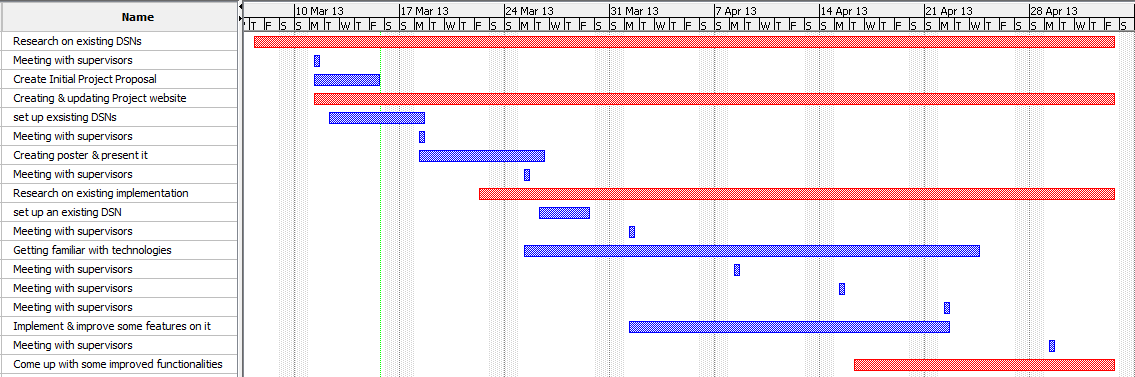
Project Plane